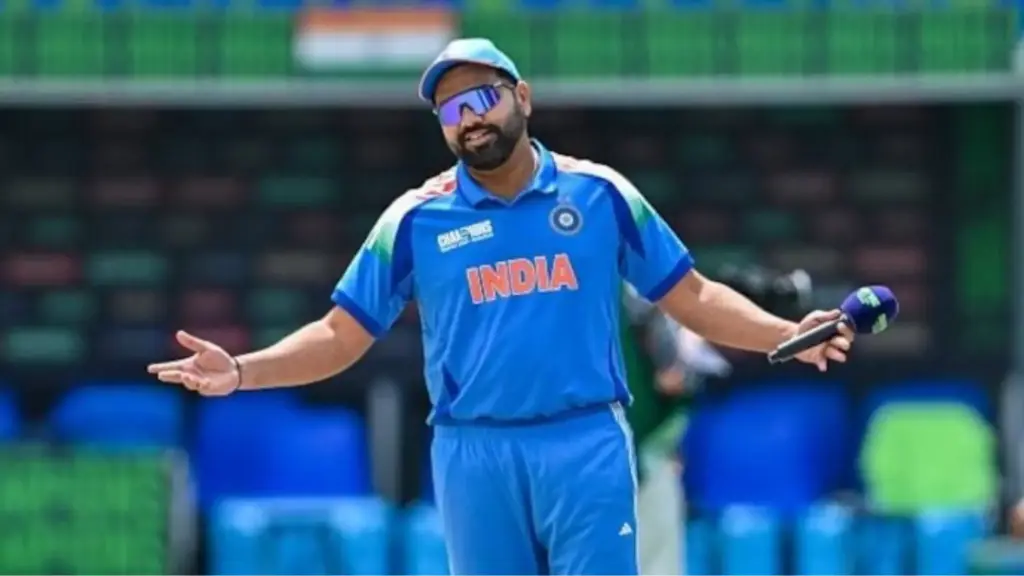
Former Indian captain Rohit Sharma has opened up about the main reason behind his decision to become a cricketer and help the national team win titles. Sharma strolled down memory lane to the 1996 ODI World Cup semi-final.
Speaking in a video on his Instagram handle, Sharma revealed how witnessing heartbreak during the 1996 ODI World Cup semi-final exit against Sri Lanka ignited his dreams of playing for the country.
“This was actually in 1996, when I was nine years old. The 1996 World Cup that we were playing in India, we lost in the semifinal against Sri Lanka. And it became quite controversial there. We got out, people started throwing things here and there, the match got stopped, and Vinod Kambli ji cried,” Sharma said in a video shared on Instagram.
“So at that time, I felt extremely sad,” he recalled. “I was nine years old, so I was thinking, ‘Man, I should be in that position one day and help India.’ So actually, from that time, it came into my mind that I should play cricket.”
“So I was nine years old, and from then on I started playing cricket. I used to play with my brothers and sisters, but that was just for fun,” Sharma explained. “But I live in Borivali, so there in the colony, matches used to happen among ourselves.
The packed Eden Gardens crowd began throwing plastic bottles, trash, and debris onto the field, and set fire to some stands in the lower tiers. Match referee Clive Lloyd suspended play and eventually abandoned the match, awarding the game to Sri Lanka by default.
“So I wanted to take part in that competition. So somehow or the other, I made it to that competition, and from there, slowly, gradually, I kept gaining the confidence that I could play good cricket. Then from there, things gradually started moving upward.”
“There are many people. Because when I was young, I couldn’t live with my parents. Because our financial conditions weren’t that good, my grandfather told my father, ‘Leave the elder one here, and take the younger one with you.’ So I was raised with my grandfather,” Sharma shared.
“Then my grandfather and my uncle – they supported me from childhood for a very long time. They took me to school, paid the school fees, paid the fees for the cricket camps that took place. So that was not easy for us at that time, but I know how my uncles did all of that, sacrificing everything of their own. They always prioritized me and my goals. Only then am I able to do whatever I am doing today; it is all thanks to them,” he added.